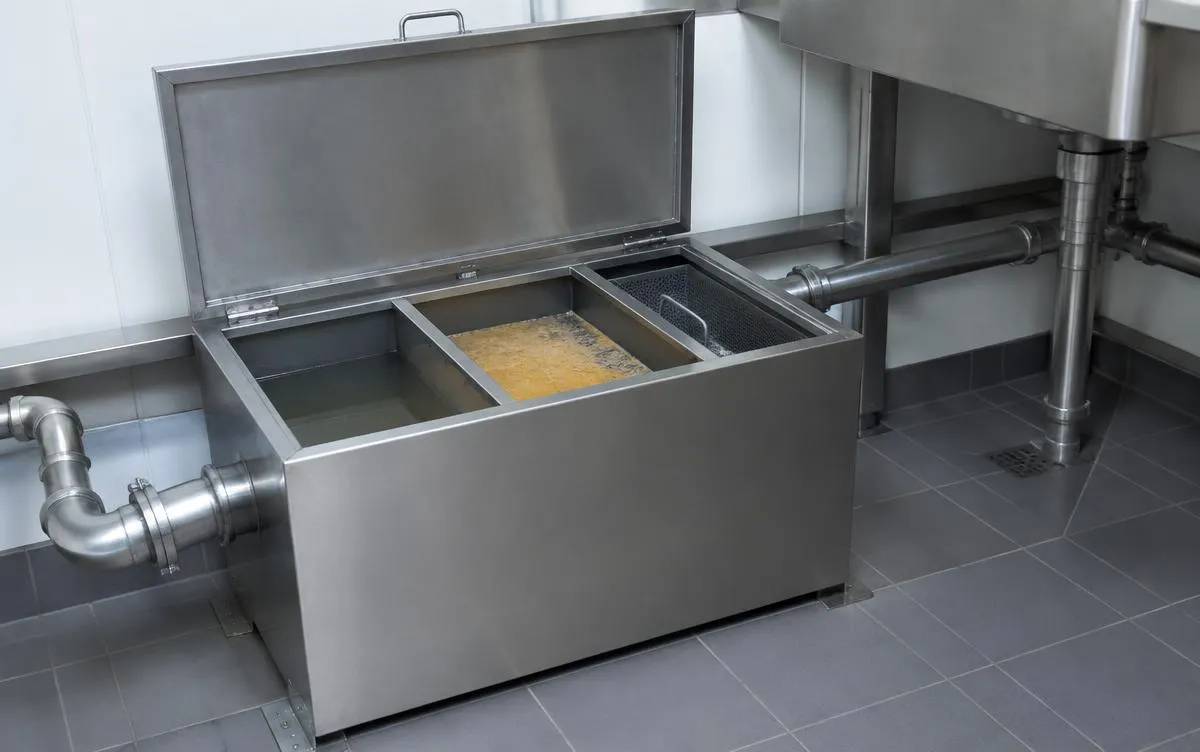
A grease interceptor does for a kitchen what a septic tank does for a house: it gives fats, oils and grease time to separate and settle so they don't reach the sewer or septic line. Unlike a home tank, a kitchen fills the grease layer fast — which is why pumping is a scheduled operating cost, not an occasional one.
Charlotte-Mecklenburg's sewer utility and the surrounding towns require food-service establishments to maintain interceptors and keep pumping records, and inspectors do ask to see them. A missed schedule shows up first as slow floor drains and odor, and later as a line blockage or a compliance problem.
Signs the trap is overdue
- Slow drainage at floor drains and three-compartment sinks
- Rancid odor near the trap or at the dish pit
- Grease visible in the downstream side when the cover is lifted
- It's been longer than your usual interval — or you don't know the interval
What a pump-out involves
The contractor removes the cover, skims the floating grease layer, vacuums the contents fully — including the settled solids at the bottom — and scrapes the walls and baffles. Partial pump-outs that leave the bottom layer behind are the reason some traps seem to fill back up immediately.
For outdoor in-ground interceptors the process is the same at a larger scale. Either way, you should receive a manifest or service record for your compliance file, and a recommended interval based on what the trap actually held.
What drives the price
- Trap size — under-sink units versus thousand-gallon outdoor interceptors
- How full it is and whether the bottom layer has hardened
- Access for the truck and hose run
- Scheduling — routine daytime visits versus emergency call-outs
Need grease trap pumping? Talk to a local pro.
Grease Trap Pumping questions
How often should a grease trap be pumped?
A common industry rule is when the trap reaches about a quarter full of grease and solids. High-volume kitchens hit that in weeks; low-volume operations take longer. The right interval comes from measuring, not guessing.
Do I need records for the health or sewer inspector?
Yes — food-service establishments are expected to keep pumping manifests. Ask the contractor for documentation at every visit.
Can you pump during business hours?
Under-sink units can usually be serviced with minimal disruption; larger interceptors are often scheduled before opening or after close to avoid odor in the dining room.
Related septic services
- Hydro Jetting & Line Cleaning — High-pressure water jetting for grease-choked kitchen lines and clogged building drains.
See the towns we serve around Charlotte, and the typical cost ranges for this kind of work.