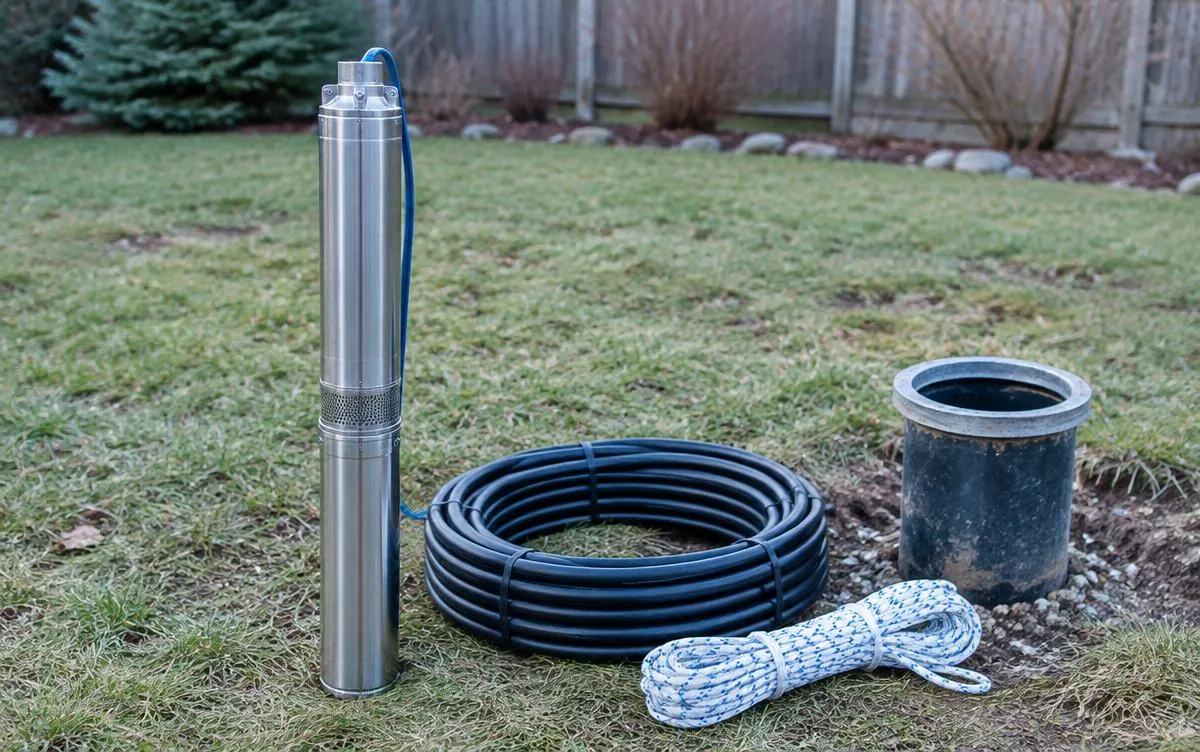
A pump that has reached the end of its working life doesn't always announce itself with a complete outage. Weak flow that creeps downward over months, rising electric bills from a pump that runs longer to do the same work, or repeated tripping are all ways an aging pump winds down. When repair stops making sense, replacement is a half-day to full-day job for most residential wells.
Replacement is also a chance to correct sizing. A pump matched to the well's yield and the household's demand runs fewer, longer cycles — and cycle count, more than hours run, is what determines how long the new one lasts.
Signs replacement is near
- The pump is past its typical working life and needs a second repair
- Flow has declined steadily even after the pressure tank and switch were ruled out
- The pump trips its overload or the breaker repeatedly
- Sand or sediment in the water from worn impellers
What replacement involves
The crew pulls the drop pipe, old pump and wiring from the well — by hand on shallow setups, with a pump hoist on deeper ones. The new pump is spliced to fresh or inspected wire, lowered on new or reusable drop pipe, and the well cap and sanitary seal are refitted.
Back at the surface, the pressure switch and tank air charge are set to match the new pump, and the system is run to confirm steady pressure. It's common sense to evaluate the pressure tank while everything is apart, since a waterlogged tank will shorten the new pump's life.
What drives the price
- Well depth — the single biggest factor in labor
- Pump horsepower and type (submersible versus jet)
- Whether drop pipe and wiring are reused or replaced
- Pressure tank replacement done at the same visit
- Access to the wellhead and emergency timing
Need submersible & jet pump replacement? Talk to a local pro.
Submersible & Jet Pump Replacement questions
How long does replacement take?
Most residential replacements are completed the same day once the crew is on site, including setting pressure and testing.
Should the pressure tank be replaced at the same time?
Not automatically, but it should be tested. Replacing a failing tank during the same visit costs far less than a return trip and protects the new pump.
Can a bigger pump fix low water pressure?
Only if the well produces enough water to feed it. Oversizing a pump on a low-yield well draws the water level down and burns out the new pump — sizing starts with the well's capacity.
Related well services
- Well Pump Repair — No water, low pressure or a cycling pump — diagnosis and repair of submersible and jet pumps.
- Well Water Testing — Lab testing for bacteria, nitrates and common well-water concerns, with a clear report.
- Well Water Treatment & Filtration — Filtration, softening and disinfection sized to what your water test actually shows.
- Well Pressure Tank Replacement — Waterlogged or failed pressure tanks swapped and set to the correct air charge.
- Well Services — New well drilling, plus inspection and maintenance guidance for existing wells.
See the towns we serve around Charlotte, and the typical cost ranges for this kind of work.