A septic tank is a settling chamber. Heavy solids sink into a sludge layer, grease floats as scum, and the clearer liquid in the middle flows out to the drain field. Bacteria digest some of the solids, never all of them. Pumping removes what accumulates before the sludge layer rises high enough to push solids out the outlet — because once solids reach the drain field, a maintenance visit has become a repair.
How often a tank needs pumping depends on its size and the household on it. EPA guidance puts a typical interval at every 3–5 years, with inspections more often; a large household on a small tank sits at the short end of that range, a couple on a big tank at the long end.
Signs you're due
- You can't name the last service date, or you just bought the house and the seller couldn't either
- Toilets and tubs drain slowly across the whole house, not just one fixture
- Gurgling in the drains after the washing machine or dishwasher runs
- Odor near the tank lids after heavy use
What a pump-out involves
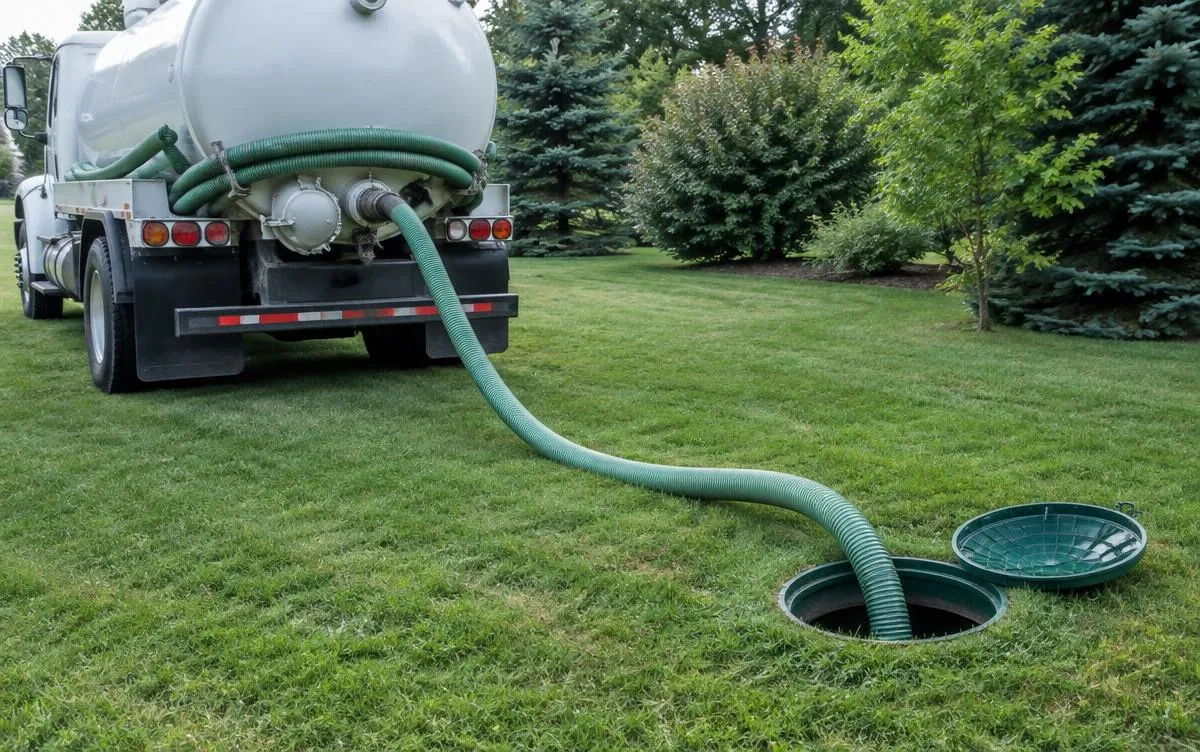
The contractor locates the tank — from county permit records, a probe rod, or a line locator — and digs down to the lids unless risers already bring them to grade. Both compartments are measured, then vacuumed out, and the sludge mat is broken up so the tank comes back clean rather than half-emptied.
While the tank is open, the inlet and outlet baffles are checked and the effluent filter, if one is fitted, gets rinsed. You should get a record of gallons pumped and anything worth watching, which is also useful documentation when you sell the house.
What drives the price
- Tank size — larger tanks cost more to pump and haul
- Whether lids are at grade or buried under clay that has to be dug out
- Distance the truck has to run hose from the driveway
- Disposal fees at the receiving treatment facility
Need septic tank pumping? Talk to a local pro.
Septic Tank Pumping questions
How do I find my septic tank?
County environmental health often has the original permit sketch. Otherwise a contractor traces the sewer line from where it leaves the house with a probe or locator. Once found, adding risers means never digging for it again.
Do I need to be home for the pump-out?
Usually not, if the lids are accessible and the truck can reach the tank. Mention pets and gate codes when you book.
Is pumping the same as an inspection?
No. Pumping empties the tank; an inspection evaluates the tank's condition and the drain field's performance. For a home sale you generally want both.
Related septic services
- Septic pump repair in Charlotte — High-water alarms, failed floats and effluent pumps that no longer move wastewater to the drain field.
- Septic Tank Repair & Replacement — Cracked lids, failed baffles, broken lines — and full tank replacement when repair isn't enough.
- Drain Field Repair & Replacement — Soggy yards and backups traced to the leach field — spot repairs or a full new field.
- Septic Inspection for Home Sale — Pre-listing and buyer inspections with written findings on tank and drain field.
- New Septic System Installation — Permits, soil evaluation, tank and drain field for new builds and failed-system replacements.
Local guides: septic tank pumping in Mint Hill, NC and septic tank pumping in Waxhaw, NC.
See the towns we serve around Charlotte, and the typical cost ranges for this kind of work.